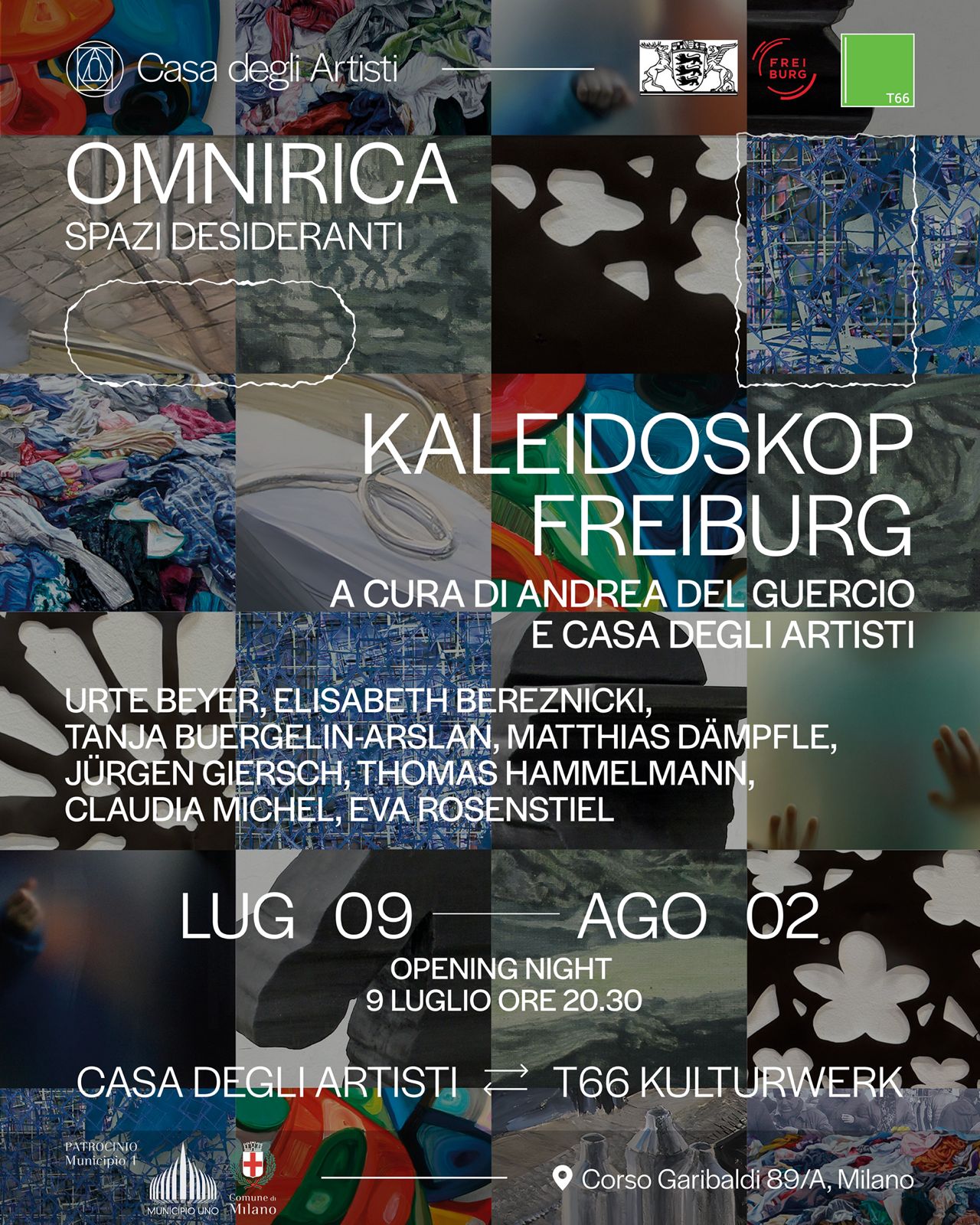

OMNIRICA - SPAZI DESIDERANTI
Kaleidoskop Freiburg 2026
Andrea B. Del Guercio
ITA
Dopo le Esposizioni di Padova al Centro Culturale San Gaetano nel 2017 e di Avellino al Museo Irpino del 2022, questa terza Edizione trova sede a Milano negli spazi espositivo-laboratoriali della Casa degli Artisti.
L’obiettivo di questo Ciclo friburghese, poi arricchitosi nel tempo tra diverse soluzioni geografico-culturali internazionali – dalla Germania alla Danimarca alla Cina – arrivando ad affermarsi e diventando un sistema diffuso, è stato sin dall’inizio quello di svelare il patrimonio espressivo articolato che la Città e il territorio racchiude; senza pretesa di completezza, ho cercato, in base alle mie capacità critiche di indagine, di documentare quegli autori che, raccolti all’interno dell’Associazione Artistica, erano in grado di ‘raccontare’ storie e interessi personali, acquisizione di tematiche e articolazione delle diverse grammatiche linguistico-visive. Accettando il principio scientifico che sta alla base del ‘caleidoscopio’ – kalos+eidos+skopein (bello-immagine-osservare) – ho inteso affermare la volontà culturale ed espositiva di tentare strade diverse percorrendole e incontrando le trasformazioni del ‘paesaggio’, dalle variabili climatiche a quelle della vegetazione, entrando in relazione con la stratificazione delle culture, rivisitandone la storia e affrontando l’innovazione…abbattendo ciò che separa per prediligere la contaminazione che insegna dando sostanza all’esperienza.
“Il nostro animo è fatto per pensare, ossia per apprendere; ora, un simile essere deve avere delle curiosità: poiché tutte le cose sono incatenate e ogni idea ne precede una e ne segue un’altra, non si può godere la vista di una cosa senza desiderare di vederne un’altra, e se non provassimo desiderio per questa, non proveremmo alcun piacere per l’altra…E’ dunque il piacere che ci dona un oggetto a condurci verso l’altro, ed è per questo che l’animo cerca sempre cose nuove, e non si sazia mai. Pertanto saremo sempre sicuri di dilettare l’animo, quando gli mostreremo molte più cose di quante avesse sperato di vedere.” (Montesquieu nel 1774)
Se il patrimonio antico della cultura è il frutto prezioso della pluralità delle voci e della dialettica che ne anima la complessità, è fondamentale che anche la contemporaneità si manifesti in tutta la sua articolazione; se la storia dell’arte, come la storia della musica e della letteratura, ha visto nella sua complessa stratificazione Maestri e allievi, i minori e molti emarginati, l’estesa popolazione degli ‘anonimi’ – in cui non mancano quelle straordinarie scoperte che una nuova sensibilità svela –prediligo e conduco un’azione critica fondata su una attenzione ‘aperta’, poi sulla contaminazione sapendo che ogni opera è in grado di sviluppare quelle variabili segrete che in essa sono racchiuse. In quest’ottica anche l’attività espositiva che contrassegna da sempre ‘Caleidoscopio’ vede attivata la ricerca del dialogo tra opere del tutto diverse, diverse per tecniche e sistemi linguistici, appartenenti a generazioni espressive e geografie anagrafiche lontane, – permettendo alla ‘fruizione’ di intervenire scegliendo, rintracciando, aggiungendo ed anche rifiutare.
“Osservo con curiosa attenzione la produzione appena sbocciata dei giovani. Da quando esposizioni liberamente organizzate danno asilo a tutte le tendenze, diviene visibile il manifestarsi di un’arte multiforme”. (Odilon Redon 15 giugno 1894)2
All’interno della Casa degli Artisti, nata nel 1909 per volontà dei fratelli Bogani, lo sviluppo espositivo troverà specifico posto nell’Atelier Nagasawa utilizzandone il dentro e il fuori, andando cioè a reinterpretare attraverso le opere la dimensione storicamente ospitale del luogo creativo, riconfermando la funzione progettuale della cultura dell’arte.
DEU
Nach den Ausstellungen in Padua im Kulturzentrum San Gaetano im Jahr 2017 und in Avellino im Museo Irpino im Jahr 2022 findet diese dritte Ausgabe in Mailand in den Ausstellungs- und Werkstatträumen der Casa degli Artisti statt.
Das Ziel dieses Freiburger Zyklus, der im Laufe der Zeit durch verschiedene internationale geografisch-kulturelle Lösungen – von Deutschland über Dänemark bis nach China – bereichert wurde, war seit Beginn, das vielschichtige Ausdruckserbe von Stadt und Region zu erschließen. Schließlich hat sich der Zyklus etabliert und entwickelte sich zu einem weit verbreiteten System. Ohne Anspruch auf Vollständigkeit habe ich versucht, auf der Grundlage meiner kritischen Untersuchungsfähigkeit jene Künstler aus dem Berufsverband Bildender Künstler zu dokumentieren, die in der Lage waren, persönliche Geschichten und Interessen zu „erzählen“, Themen zu erfassen und die verschiedenen sprachlich-visuellen Ausdrucksformen zu vermitteln. Indem ich das wissenschaftliche Prinzip akzeptierte, das dem „Kaleidoskop“ zugrunde liegt – kalos+eidos+skopein (schön-Bild-beobachten) – wollte ich den kulturellen und kuratorischen Willen bekräftigen, neue Wege zu beschreiten, sie zu erkunden und dabei den Veränderungen der „Landschaft“ zu begegnen, von klimatischen bis zu denen der Vegetation, indem wir uns mit der Vielschichtigkeit der Kulturen auseinandersetzen, ihre Geschichte neu beleuchten und uns mit Innovation befassen… das zu überwinden, was trennt, um der gegenseitigen Befruchtung den Vorrang zu geben, die lehrt, indem sie der Erfahrung Substanz verleiht.
„Unsere Seele ist dazu gemacht, zu denken, zu lernen, das ist, Ideen zu empfangen; ein solches beseeltes Wesen aber muss Neugierde besitzen: denn eil alle Dinge in einer Kette zusammenhängen, wo jeder Begriff einem anderen vorhergehet und auf einen anderen folgt, kann man keine Lust finden, ein Ding zu sehen, ohne zu wünschen wieder ein anderes zu sehen; und wenn wir dieses Verlangen nach jenem nicht hätten … Das Vergnügen, das der Gegenstand uns gibt, ist also dasjenige, wodurch wir nach einem anderen Gegenstande gelenkt werden; daher kommt es, dass die Seele jederzeit neue Dinge suchet, und niemals ruht. Folglich wird man alzeit gewiss sein, der Seele zu gefallen, wenn man ihr viele oder auch mehr Dinge zeigen wird, als sie zu sehen gehofft hatte.“ (Montesquieu, 1774, Versuch über den Geschmack)
Wenn das antike Kulturerbe die kostbare Frucht der Vielfalt der Stimmen und der Dialektik ist, die seine Komplexität belebt, ist es von zentraler Bedeutung, dass sich auch die Gegenwart in ihrer ganzen Vielschichtigkeit zeigt; wenn die Kunst- wie die Musik- und Literaturgeschichte, in ihrer komplexen Schichtung von Meistern und Schülern, die Minderheiten und viele Ausgegrenzte, die große Gruppe der „Anonymen“ umfasst – unter denen es nicht an außergewöhnlichen Entdeckungen mangelt, die eine neue Sensibilität offenbart –, so bevorzuge und verfolge ich eine kritische Herangehensweise, die in einer „offenen“ Aufmerksamkeit und dann auf der gegenseitigen Befruchtung gründet, in dem Wissen, dass jedes Werk in der Lage ist, jene geheimen Wechselwirkungen zu entfalten, die in ihm verborgen sind. In diesem Sinne ist auch die Ausstellungstätigkeit, die „Kaleidoskop“ schon immer auszeichnet, von der Suche nach einem Dialog zwischen völlig unterschiedlichen Werken geprägt, die sich in Techniken und Ausdrucksweisen unterscheiden und zu weit voneinander entfernten Generationen und geografischen Orten gehören – wodurch die „Rezeption“ die Möglichkeit bekommt, durch Auswählen, Aufspüren, Hinzufügen aber auch Ablehnen einzugreifen.
„Ich beobachte mit neugieriger Aufmerksamkeit das gerade erst erblühende Schaffen der Jugend. Seit frei organisierte Ausstellungen allen Strömungen Raum geben, wird das Aufkommen einer vielgestaltigen Kunst sichtbar.“ (Odilon Redon, 15. Juni 1894)
Innerhalb der „Casa degli Artisti“, die 1909 auf Initiative der Brüder Bogani gegründet wurde, findet die Ausstellung im Atelier Nagasawa ihren besonderen Platz, wobei sowohl der Innen- als auch der Außenbereich genutzt werden. So wird durch die Werke die historisch gastfreundliche Dimension des kreativen Ortes neu interpretiert und die gestalterische Aufgabe der Bildenden Kunst bekräftigt.
ENG
Following exhibitions at the San Gaetano Cultural Center in Padua (2017) and the Museo Irpino in Avellino (2022), this third edition is hosted in Milan within the exhibition and workshop spaces of the Casa degli Artisti.
From the outset, the goal of this “Freiburg cycle”—which has since expanded across diverse international geographic and cultural contexts, ranging from Germany and Denmark to China, eventually establishing itself as a widespread system—was to reveal the rich, multifaceted expressive heritage held by the city and its territory. Without claiming to be exhaustive, I have sought—drawing on my own critical analytical skills—to document the artists associated with the *Associazione Artistica* who were capable of “telling” personal stories and interests, exploring specific themes, and articulating diverse visual-linguistic grammars. Embracing the scientific principle underlying the “kaleidoscope”—*kalos* + *eidos* + *skopein* (beauty, image, to observe)—I aimed to assert a cultural and curatorial commitment to exploring new paths. This involved engaging with the transformations of the “landscape”—from climatic variables to changes in vegetation—and interacting with the stratification of cultures, revisiting history, and embracing innovation. It meant breaking down barriers to favor a cross-pollination that educates, thereby giving substance to the experience. “Our mind is made for thinking—that is, for learning; naturally, such a being must possess curiosity. Since all things are interconnected, with every idea both preceded and followed by another, one cannot enjoy the sight of one thing without desiring to see another; indeed, were we to feel no desire for the latter, we would derive no pleasure from the former. It is, therefore, the pleasure an object affords us that leads us to the next; this is why the mind constantly seeks new things and is never sated. Thus, we may be certain of delighting the mind whenever we reveal to it far more than it had hoped to see.” (Montesquieu, 1774).
If our cultural heritage is the precious fruit of a plurality of voices and the dialectic that animates their complexity, it is essential that the contemporary era also reveal itself in all its multifaceted nature. Just as the history of art—like that of music and literature—encompasses a complex layering of masters and pupils, minor figures and the marginalized, and a vast population of “anonymous” creators (among whom lie extraordinary discoveries revealed by new sensibilities), I favor and pursue a critical approach grounded in “open” attention and cross-pollination, recognizing that every work holds the potential to unfold the secret variables contained within it. In this spirit, the exhibition activities that have always defined “Caleidoscopio” foster a dialogue between vastly different works—diverse in technique and visual language, and spanning distant generations and geographies—thereby allowing the viewer to engage actively by choosing, tracing connections, adding, or even rejecting.
“I observe the newly emerging work of young artists with curious attention. Ever since freely organized exhibitions began to provide a home for every trend, the manifestation of a multifaceted art has become visible.” (Odilon Redon, June 15, 1894)
At the Casa degli Artisti—established in 1909 by the Bogani brothers—the exhibition will take place specifically within the Nagasawa Atelier, utilizing both its interior and exterior spaces. Through the artworks, the project reinterprets the creative venue’s historically welcoming nature, reaffirming the generative role of art and culture.