
PRECIOUS MATERIALSFive Gallery
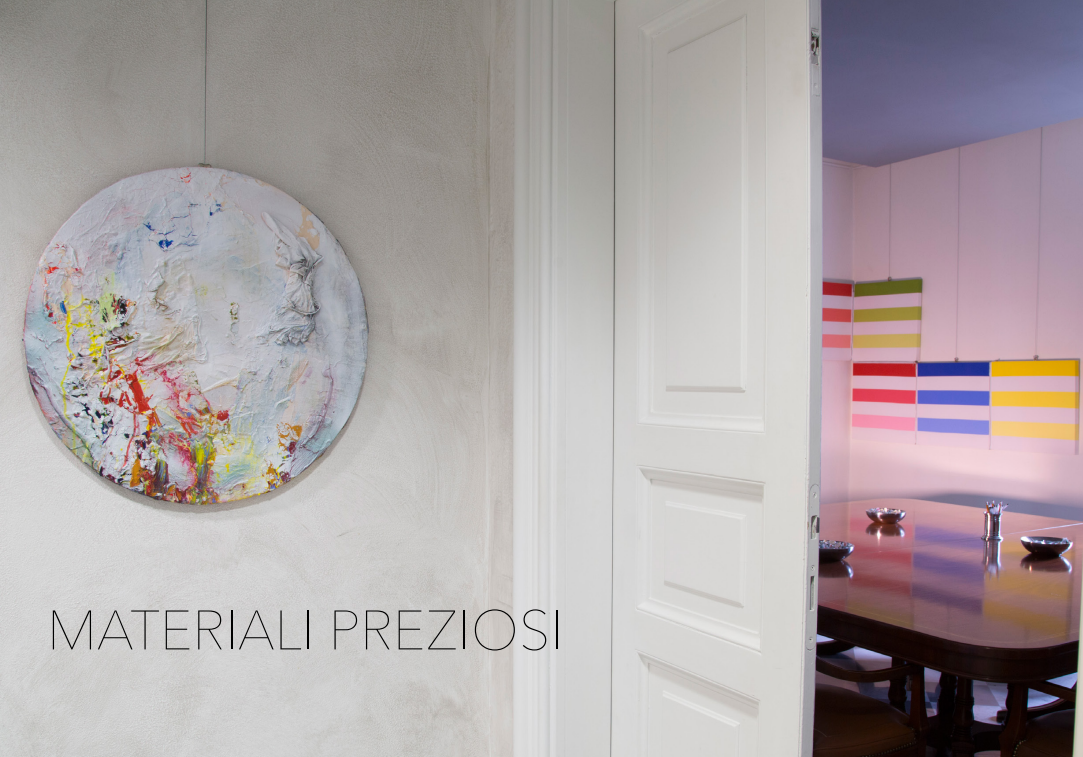
The photographic documentation prepared by Andrea Sartori allows us to experience the aesthetics of the space: the common areas, especially the meeting rooms, but also the private studios, characterized by the distribution of fragments of artistic expression, independent of one another and protected by an intimate concept of art, a creative process that follows discrete rules and objectives.
This collection of works was inspired by the theme of “preciousness,” of rarity as the specific value of behaviors and relationships; the aim was to create an ideal connection around the value of preciousness between the Studio’s activities and those of artistic communication.
The theme, understood as an experiential form and not according to the typical iconography of 1960s pop culture, was approached following the preferred approach, oriented towards targeted systems of artistic expression. The young artists invited responded with their best works, aiming to demonstrate the value of each individual process; That is, they intended to exhibit material that could demonstrate a culture that works on the sensitive perception of reality, on reinterpretation and poetic reinterpretation. Each work, emblematic of different linguistic-visual paths, clearly independent of one another, speaks, communicating the relationship between perception and transcription: Ilaria Forlini interprets the illuminated culture of the herbarium, Giuseppe De Siati with the analytical transcription of energy in the iconography of the tree, Carmine Sabbatella capable of filtering the tensions of contemporary civilization, Chiara Lupi with the transcription of dance in his large sheets of graphic art, Melissa Provezza with her leafing through the unattainable image of privacy, Valentina Sonzogni who lingers on the intimacy of the body through the non-descriptive medium of painting, Daniela Conte, with a focused testimony to the intimate energy of color and its vital magma, Giulio Pace who pursues the lightness and movement of the drawn form, Lucrezia Zaffarano with a project dedicated to clothing, and Lucia Guadalupe
with the joyful exasperation of children’s clothes.
Throughout this process, each artist demonstrates having identified the thematic area to which the most appropriate linguistic choice can be applied; each work, from a small fragment to an artifact of greater spatial weight, bears witness to these processes, clearly perceptible in the Studio’s environmental context. Indeed, it must be emphasized that the Collection of works distributed in a private space allows for a clearer understanding and appreciation of their value; by replacing the exhibition space of a gallery with small rooms and corridors, the visitor’s relationship with the work becomes a more intimate one, often within close proximity and in many cases prolonged over the lengthy duration of a meeting and exchange of ideas.
In this context, we believe that the presence of art is an indirect yet significant contribution to professional activities and social relations.