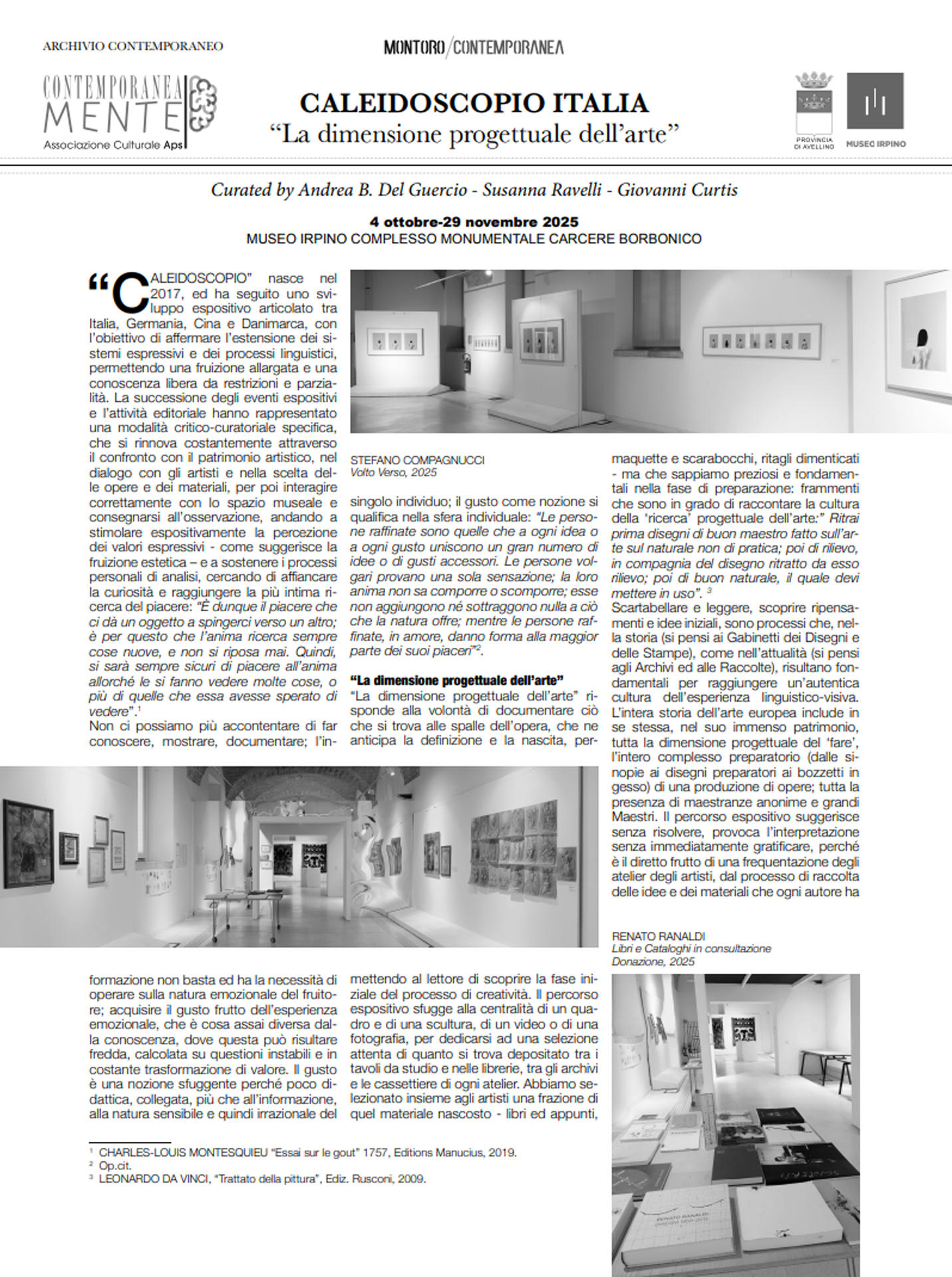

“CALEIDOSCOPIO” was born in 2017 and has followed a structured exhibition development in Italy, Germany, China, and Denmark, with the aim of affirming the breadth of expressive systems and linguistic processes, allowing for a broad enjoyment and a knowledge free from restrictions and bias. The succession of exhibitions and publishing activities have represented a specific critical-curatorial approach, constantly renewed through engagement with the artistic heritage, in dialogue with the artists, and in the selection of works and materials. This approach then interacts appropriately with the museum space and offers itself to observation. Through exhibitions, the perception of expressive values—as aesthetic enjoyment suggests—is stimulated, and personal processes of analysis are supported, seeking to foster
curiosity and achieve the most intimate pursuit of pleasure: “It is therefore the pleasure that an object gives us that drives us toward another; this is why the soul always seeks new things and never rests.
You will always be sure to please the soul when you show it many things, or more than it had hoped to see.”
We can no longer be content with simply informing, showing, and documenting; information is not enough and must work on the emotional nature of the viewer; Acquiring taste as the fruit of emotional experience, which is very different from knowledge, where knowledge can be cold, calculated on unstable issues and constantly shifting in value. Taste is an elusive notion because it is not very didactic, linked more to the sensitive and therefore irrational nature of the individual than to information; taste as a notion is defined in the individual sphere: “Refined people are those who combine a great number of accessory ideas or tastes with each idea or each taste. Vulgar people experience only one sensation; their soul does not know how to compose or decompose; they neither add nor subtract anything from what nature offers; while refined people, in love, give form to most of its pleasures.”